

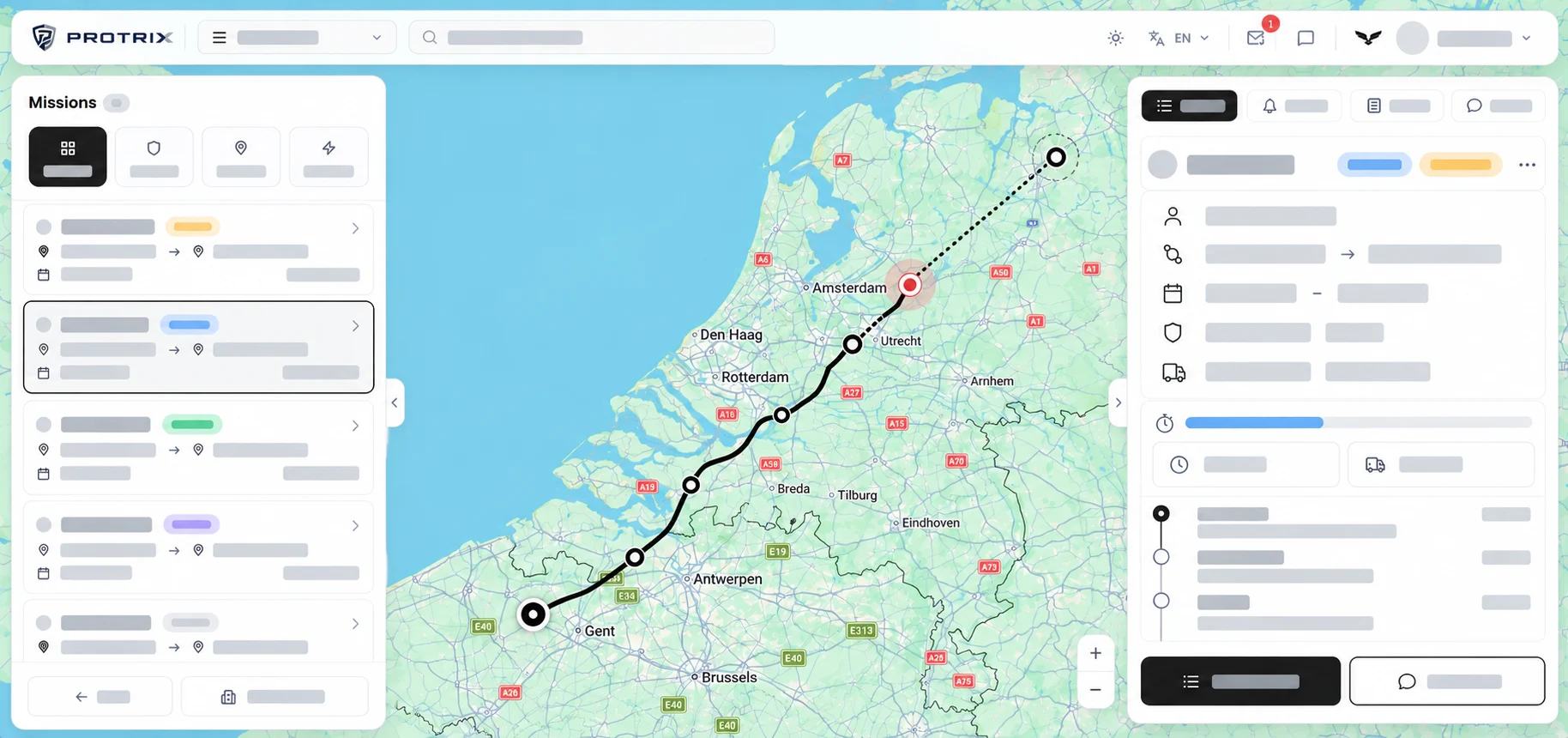


Escort work is coordinated in tools that were never built to hold a mission.
A protected transport has a route, a schedule, a vetted detail, a customer approval, a chain of field events and an invoice per leg. When those live in four places, the operation runs on the memory of whoever answered the phone, and the record you need three weeks later does not exist.
Spreadsheets and WhatsApp groups
Route agreed in a chat, price agreed by phone, detail confirmed by voice note. Nothing is queryable, nothing is auditable, and the customer has no visibility without someone typing an update.
Generic field-service software
Jobs and technicians, not missions and details. No route corridors, no escort vehicle pairing, no panic path, no subcontractor payout per leg, no customer-side approval of a quote.
Tracking without a policy
Consumer GPS apps left running on personal phones. You are tracking staff at work, and that needs a bounded, documented policy, not an always-on location feed nobody signed off.

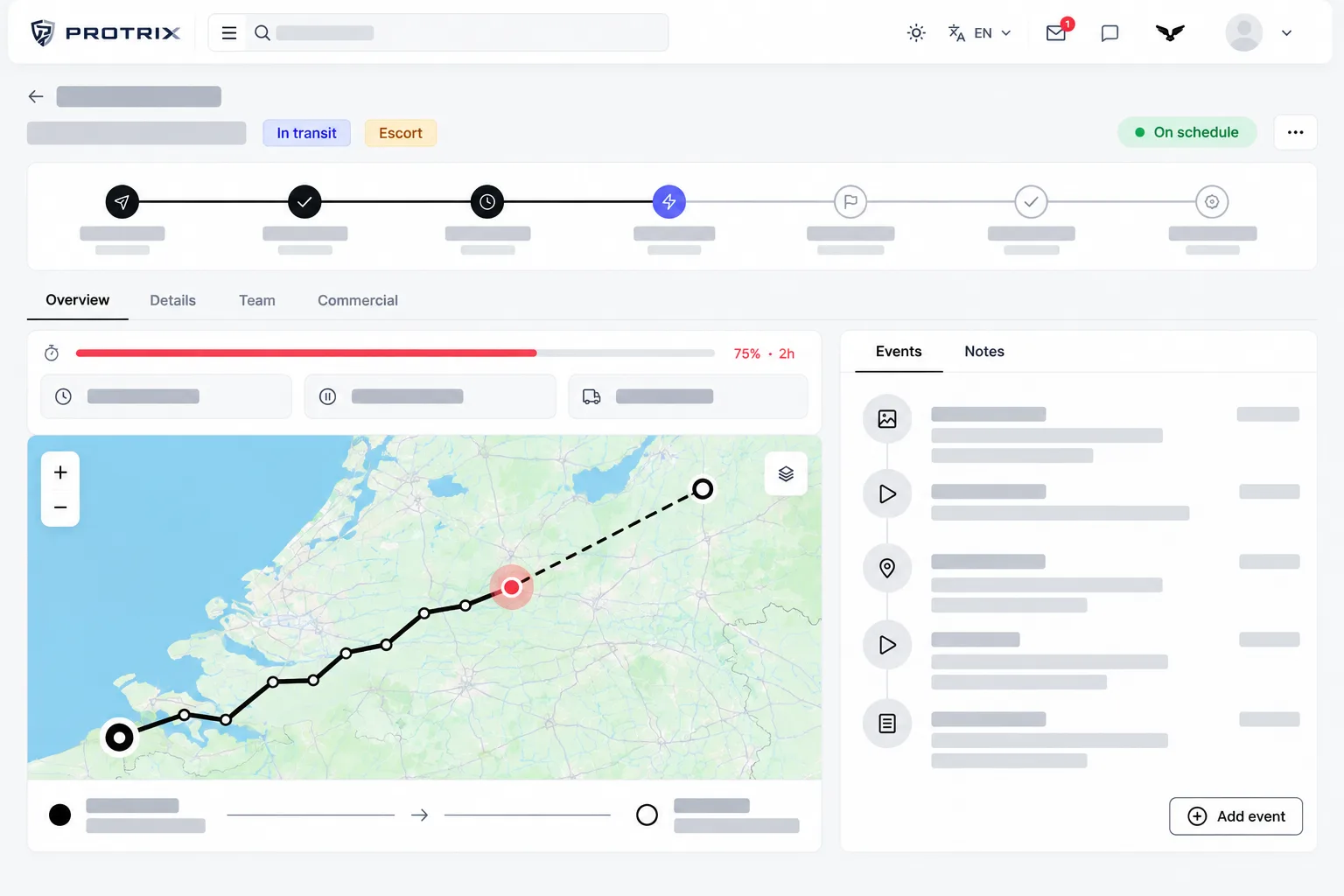
- 01Mission headerMission code, customer, corridor, status chip, escalation state.
- 02Route & live positionPlanned corridor, current segment, GPS position, stop history with timestamps.
- 03Event timelineStatus changes, evidence photos, stop logs and alarms, in the order they happened.
- 04Assigned detailGuards, vehicles, trailers and drivers on this mission, own staff or subcontractor.
- 05CommercialsQuote, customer approval, digital sign-off, itemised invoice lines per leg, subcontractor payout.
Requests & dispatch
Customers submit escort requests with route, vehicle and schedule. The operator confirms, prices and dispatches to a vetted detail or subcontractor.
Live mission tracking
Every escort on one map: GPS position, current route segment, stop history and mission status, updated as the field reports it.
Saved routes & re-trigger
Recurring corridors stored with their agreed pricing. Re-trigger a mission in seconds from a saved route code instead of rebuilding it.
Fleet & security detail
Guards, vehicles, trailers and drivers held per organisation and assigned per mission, so the detail on the job is always a matter of record.
Guard mobile app
Guards run the mission from the phone: status changes, GPS, evidence photos, stop logs and a panic path, with no calling in to a dispatcher.
Command center
Field incidents and alarms triaged in one screen, with the mission, the detail and the position already attached to the event.
Messaging with auto-translation
Mission-scoped threads with automatic translation, so a Polish driver, a Dutch dispatcher and a German customer each write in their own language.
Quotes, approvals & invoicing
Quotes generate a PDF and become invoices on acceptance. Completed missions get a digital sign-off; invoices are itemised per leg, with subcontractor payouts alongside.
Multi-party by design
One platform serving the operator, their customers, their subcontractors and their guards, each with a role-scoped view of the same mission.
Five jobs on one platform, each seeing only their part of the mission.


Built inside a working escort-logistics operation.
Protectrans runs its escort and cargo-protection operation on Protrix. The platform was designed against real dispatch, real field reporting and real invoicing, not a product brief.
The operators named here are customers and reference operations. Their certifications, licences and field capability belong to them, not to Protrix. Protrix is software: it does not operate vehicles, employ guards or run a control room.

Customer quote to be supplied. One operational claim, attributed to a named role at a named operator. Do not publish until approved in writing.
A platform that tracks people at work has to be explicit about it.
Protrix holds route data, staff positions and customer cargo details. That is exactly the data a works council, a DPO and an insurer will ask about, so the answers are written down rather than implied by a padlock icon.
EU-hosted
Data resides in the EU. Sub-processors are documented and listed, not discovered later.
Invite-only, role-scoped
No public signup. Accounts are provisioned per organisation; each role sees only its part of a mission.
Encrypted in transit and at rest
Mission records, evidence and messages are encrypted, with retention defined per data class.
Route-tracking DPIA
A data protection impact assessment for location tracking, available to review during procurement.
Location capture is bounded server-side, not "always on".
Position is captured against an explicit server-side policy tied to mission state, not left to a device setting or a habit. Guards are not tracked between missions, and the boundary is enforced by the platform rather than by instruction.
Protrix does not hold operational security certifications. ISO 9001, TAPA, VBe and ASIS credentials named in this market belong to the operating companies that hold them, including Protectrans and CargoProtect Overwatch, and are never claimed by or transferred to Protrix.
See it against your own corridors.
A 45-minute walkthrough of the console, the guard app and the invoicing path, using a route and a mission shape you actually run.